 and
and
 ,
and each type is equally likely. Show that truthful bidding is a dominant
strategy for the type.
Repeat for the type.
,
and each type is equally likely. Show that truthful bidding is a dominant
strategy for the type.
Repeat for the type.23.4 Suppose that there are N bidders; each bidder is one of two types,
and
,
and each type is equally likely. Show that truthful bidding is a dominant
strategy for the type.
Repeat for the type.
A
type
bidder could bid +
1 and be certain that he will win against any other type.
But there is a risk in doing so. As long as no other type
bidder plays this same strategy and they all bid truthfully then the one bidder
that applies the strategy will only pay and
have zero net gain. But suppose some other
players recognize this strategy and some don't. Those who have seen the
strategy will find the auction being decided by chance among the j players who
have seen the strategy. The winner will pay ,
the next lowest bid, and have zero net gain 1/j % of the time. As long as
j < then number of type
bidders, this is a good strategy. But all types
will see the opportunity and they will all want to bid a little above .
When they all see the opportunity the winner will be decided by chance and will
pay ,
the next highest bid, for a net gain of -
.
But this would be the same net gain if they all bid truthfully to begin with, so
they will.
The
type
person will never bid below because
he will never win if there is at least one other type
in the pool of bidders. Not knowing whether there is another type
bidder, the person will not risk losing the auction. Even if he is the
only type
person, he will never bid since
then his fate is left to chance when he could have won the auction with
certainty.
23.5
What is the probability of winning for a type
bidder?
In
general we need to find P(win|# of other players)xP(#
of other players)
for #=0,1,2,3,...N-1,
Let
p(0) be the probability that there are no other type
people. Since there are a total of N bidders and one of them is known to be there
are N-1 others to be decided. A given bidder is assigned to be either or
with
equal probability (1/2). So, the probability that all N-1 of the remaining
bidders are is
(1/2)N-1.
In this case, since bidding truthfully is dominant, she will win with certainty.
Let
p(1) be the probability that there is exactly 1 other player.
The probability of exactly 1 other
player
is (1/2)(1/2)N-1. But there are N-1 ways to do this.
To
find out p(j) we need to use the binomial theorem, which is 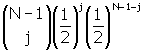 .
.
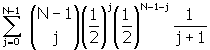
Putting the pieces together
P(win)
= 
To
find the expected payoff just multiply this by -
.
23.6 Repeat the question for a
type
player.
There
is only one way a
type player can win; That is when every other player is also a type.
This probability is (1/2)N-1. The probability of a win when
every player is of the same type is (1/N), and so the total probability is
(1/N)(1/2)N-1 .
Since
this is a second price auction, everyone is of the same type, and players bid
truthfully even a winner has zero net gain. SO the expected winnings for a
type
player is zero.