PROBABILITY and EXPECTED VALUE
We begin with three definitions of
probability.
CLASSICAL: the probability of an event is the ratio of the number of ways
an event can occur to the total number of outcomes when each outcome is equally likely. An
EVENT is the outcome of an experiment.
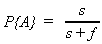
let s = # of ways of getting A
f = # of ways A cannot occur
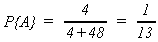
If we define success as picking an ace from a deck then
RELATIVE FREQUENCY: let
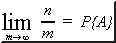
n be the number of successes, i.e., the occurrence of A, and let m be the number of trials
As  the ratio of n to m approaches the probability
of the event A:
the ratio of n to m approaches the probability
of the event A:

i.e.,
SUBJECTIVE: Degree of
rational belief. The probability of an event occurring is what you feel it to be.
This is closely akin to the notion of a prior probability in Bayesian analysis.
SOME MORE DEFINITIONS
Consider an experiment with N possible outcomes. The set of outcomes in called the sample
space.
An event is a subset of the sample space, call the event A.
The probability of an event "A"
is the number of outcomes in "A" divided by the number of elements in the sample
space.
Example: Flip two coins. The
possible outcomes are
{HH, HT, TH, TT} = sample space
Example: Choose a card at random
from a fair deck. What is the probability of a face card or a heart?
A = face or heart
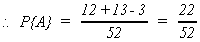
there are 13 hearts and 12 face cards, but 3 of the hearts are face cards
SET THEORY
 The (set or event) C consists of the set of all points x such that x lies between zero and
infinity.
The (set or event) C consists of the set of all points x such that x lies between zero and
infinity.
 The
set C consists of all points x such that x is in both A and B.
The
set C consists of all points x such that x is in both A and B.
 This is an example of the null set.
COMPLEMENT OF AN EVENT
The complement of an event A is denoted
by  .
.
Let S be the sample space, of which A is
a subset i.e.,  then the complement of A is the set of
points left
after we take those belonging to A out of the sample space S.
then the complement of A is the set of
points left
after we take those belonging to A out of the sample space S.
Using a Venn diagram
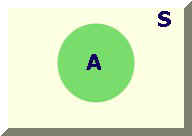
 is the yellow shaded portion.
Using set notation
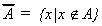
Example:

MUTUALLY EXCLUSIVE EVENTS
If A and B are mutually exclusive events
then the occurrence of one precludes the occurrence of the other.
Examples:
1. on a coin flip H and T are mutually
exclusive
2. on the roll of a die the events
"roll a 1" and "roll a 3" are mutually exclusive.
MUTUALLY EXCLUSIVE AND COLLECTIVELY
EXHAUSTIVE
If A and B are mutually exclusive they
cannot both occur at the same time. If they are collectively exhaustive then they contain,
between them, all possible outcomes in the sample space.
Example:
1. On a coin flip H and T are mutually
exclusive and collectively exhaustive.
2. "Roll a 1" and "Roll a
3" are mutually exclusive but not collectively exhaustive.
INTERSECTION
Let X represent the points of a sample
space S.
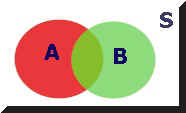
Let A and B represent two subsets of this sample space
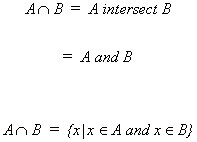 We can represent their intersection algebraically as
shown at the left. In the diagram the intersection is the lens formed where A and B
overlap.
We can represent their intersection algebraically as
shown at the left. In the diagram the intersection is the lens formed where A and B
overlap.
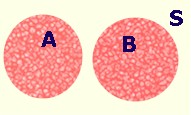
Suppose A and B do not have any points in
common, i.e., they are mutually exclusive, then the Venn diagram representation looks like:
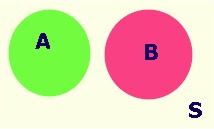 If a point belongs
to A then it cannot belong to B, and vice versa. There are no points in common to
both A and B.
If a point belongs
to A then it cannot belong to B, and vice versa. There are no points in common to
both A and B.

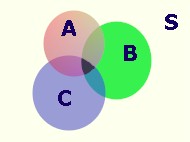
We can extend the idea of
intersection to more than two sets.

UNION OF TWO EVENTS
The set of points that are in either or
both of two events
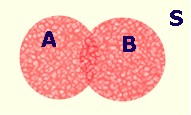
These two Venn diagrams differ to the
extent that there are no points in common between A and B in the second diagram.

COMPLEMENTARITY AND CONDITIONAL
PROBABILITY
COMPLEMENTS
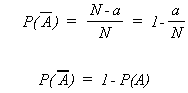
Let the sample space contain N sample points and event A contain "a" of these points. Then from our previous definition

 consists of (N -
a) points, so
consists of (N -
a) points, so
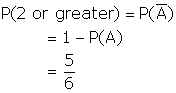
Example: Define event A as rolling a
single die and getting a one. As a result, we define  as rolling a
2, 3, 4, 5 or 6
as rolling a
2, 3, 4, 5 or 6
Now we are asked to find the probability of rolling a 2 or greater
CONDITIONAL PROBABILITY
Consider the type of question such that
we are interested in the occurrence of one event given that another has occurred
In set notation

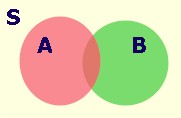
since we know B has occurred we need not worry about all of S
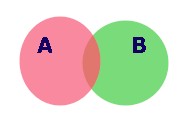
Our sample space is only the points in B and A B is the set of
points common to both A and B, shown by the darker lens in the diagram.
B is the set of
points common to both A and B, shown by the darker lens in the diagram.
Suppose that there are N points in the sample space, "b" points in B and
"a" in the set A. Also, let there be W points in common between A and B.
The relative frequency of A|B can be determined from

and using our definition of probability
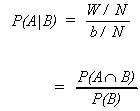
also
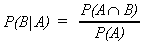
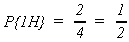
Example: Compute the probability of H on
the second toss of fair coin given H on the first toss.
S = {H1H2, H1T2,
T1H2, T1T2}
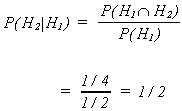
Example: Let A be the event 2 is drawn
B be the event Heart is drawn
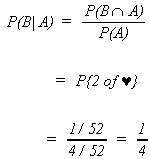
Note that in both of these examples the two events are independent. What test for independence can you devise from this result?
MULTIPLICATION RULE
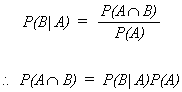
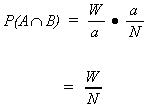
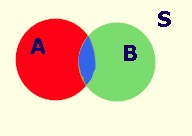 There are W
points in the blue lens, a in the set A, and N in the sample space. From this we can
calculate the probability of the intersection.
There are W
points in the blue lens, a in the set A, and N in the sample space. From this we can
calculate the probability of the intersection.
INDEPENDENCE

If A and B are independent then the fact that one has occurred has no bearing on whether
or not the other occurs.

Example:

The first flip of the coin has no bearing
on the outcome of the second flip.
Example: let A be the event a 2 is drawn
let B be the event a Heart is drawn
P(B) = 1/4
P(A) = 1/13
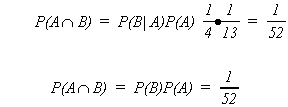
There is a special multiplication rule for independent events.

ADDITION RULE

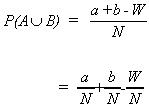 Note that we have to subtract out the points in common, otherwise
we would double count.
Note that we have to subtract out the points in common, otherwise
we would double count.

Example: Choose a card at random
A = face card
B = heart
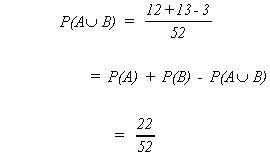
Suppose two events are mutually exclusive, i.e.,
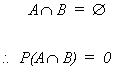
then

Since sets A and B don't overlap we don't have to subtract for double counting.
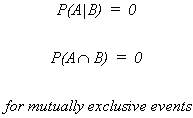
Question: Can two events be both mutually exclusive and independent?

but
An interactive notebook will help cement these notions.
BAYES RULE
Suppose we have the events A,
B.
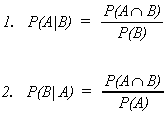
Upon rearranging 1 and 2,
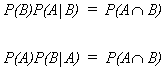
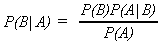
equating these two gives

rearranging
Example: There are three chests in a
room. Each chest has two drawers each containing a single coin
G |
G |
S |
||
G |
S |
S |
||
I |
II |
III |
An individual staggers into the darkened
room, opens a drawer, grabs a coin and staggers out. In the light it is observed that he
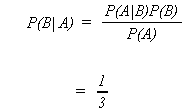
has a gold coin. What is the probability that he got it from chest II?
A = gold coin
B = chest II


MARGINAL PROBABILITY
We can arrange much of our information into a table

|
 |
||
 |

|
 |

|
 |

|
 |

|

|
 |
The probabilities on the edges of the
table are marginal probabilities.
RANDOM VARIABLES AND PROBABILITY
FUNCTIONS
Definition: A random variable X is a function or rule that results in a mapping from the sample space to the real numbers: X:S ==> R
or
A random variable takes a possible
outcome and assigns a number to it.
Example: Flip a coin five times, let X be
the number of heads in five tosses.
X = { 0, 1, 2, 3, 4, 5}
Definition: A probability distribution
assigns probabilities to all possible outcomes of an experiment.
Example: The experiment is five flips of
a coin, the random variable counts the number of heads and the probability distribution
assigns a set of likelihoods to the possible outcomes.
X |
P(X) |
0 |
.03125 |
1 |
.15625 |
2 |
.31250 |
3 |
.31250 |
4 |
.15625 |
5 |
.03125 |
| 1.00000 |
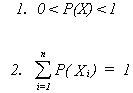
If we were to do more examples we would surmise the following axioms of probability
 Any
probability must be between zero and one. The sum of the probabilities assigned to
all of the possible outcomes must be one.
Any
probability must be between zero and one. The sum of the probabilities assigned to
all of the possible outcomes must be one.
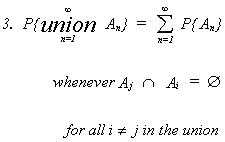
A third, less obvious axiom is
 The
probability of the union of all the disjoint sets must equal the sum of the probabilities
of those sets occurring individually.
The
probability of the union of all the disjoint sets must equal the sum of the probabilities
of those sets occurring individually.
EXPECTATION
We are now prepared to introduce the
notion of mathematical expectation. We begin the development with an example.
Example: Flip two coins. For each head
that appears you receive $2 from your rich uncle. For each tail you pay him $1. The
outcomes, or points in the sample space, of the experiment are
X = amount you receive |
|
HH |
4 |
HT |
1 |
TH |
1 |
TT |
-2 |
As an astute player you should be interested in the probability of a particular $ outcome of the game. The game assigns a dollar value to each of the four possible H-T outcomes. Since two of them are monetarily the same we get the following random variable and distribution:
X |
P(X = x) |
$4 |
1/4 |
$1 |
1/2 |
-$2 |
1/4 |
After explaining the above game, your
uncle asks how much you are willing to pay in order to play.
You are not interested in your expected
winnings on any given pair of throws, but you are interested in your long run winnings, or
what you could expect to win if you played the game many times. We could repeat the
experiment an infinite number of times and calculate the average payoff per trial. There
is an easier way to determine this average than flipping coins for the rest of our lives.
Expected value is merely a weighted
average. Your grade point average is a weighted average. The weights in
the coin toss game are the probabilities that an outcome will occur.
Think of how we would calculate the mean
if we were to flip a large number of pairs of coins.
We would use the following:
Ex = 
We read this as "The expected value of x is equal to the population mean; it is computed as the frequency weighted average of the values taken by the random variable x.
where xi is our winning of the
ith type and fi is the number of times that outcome occurred in N
trials.
But note that fi/N is nothing
more than a probability when  .
.
Since our probability distribution has
already let it seems reasonable to use
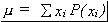
for calculation of our expected winnings.
For the coin game
X |
P(X = x) |
X P(X) |
4 |
1/4 |
1 |
1 |
1/2 |
1/2 |
-2 |
1/4 |
-1/2 |
so

Our long run average winnings will be $1 per toss. We would never pay more than that to play.
If we wish to find the variance for our winnings we could again use expectations. Namely,
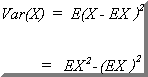 This is a definition. With time and space we could
demonstrate its relationship to the population variance you may have learned about in your
basic statistics course.
This is a definition. With time and space we could
demonstrate its relationship to the population variance you may have learned about in your
basic statistics course.
For the coin game

X |
X2 |
P(X) |
X2P(X) |
4 |
16 |
1/4 |
4 |
1 |
1 |
1/2 |
1/2 |
-2 |
4 |
1/4 |
1 |
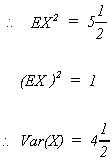
There are some general rules for
mathematical expectation.
RULE 1
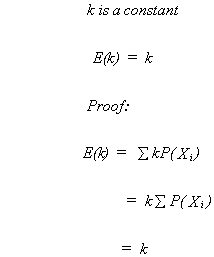
RULE 2
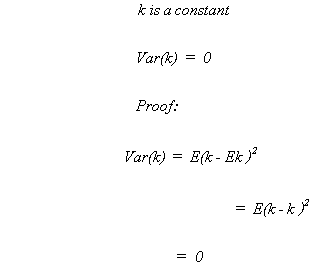
RULE 3
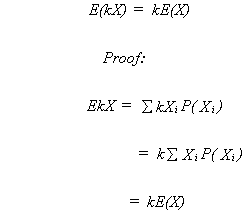
RULE 4
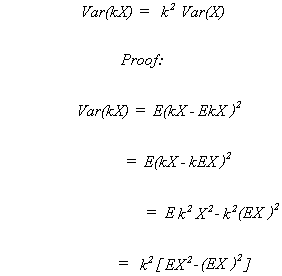
RULE 5
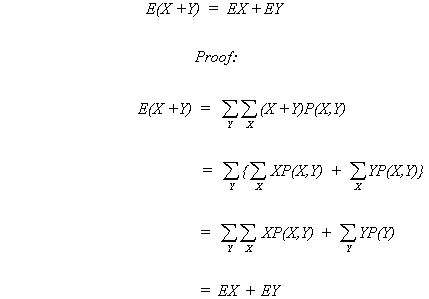
As a note: X, Y are random variables with a joint probability function.

Also,

but,
